AI has officially moved past “buzzword” status and into “all-consuming” territory. To put its scale into perspective, the energy required to power these models is roughly equivalent to the annual power consumption of Argentina. It’s the first thing on every marketer’s mind and the centerpiece of every major tech earnings call.
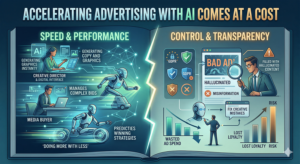
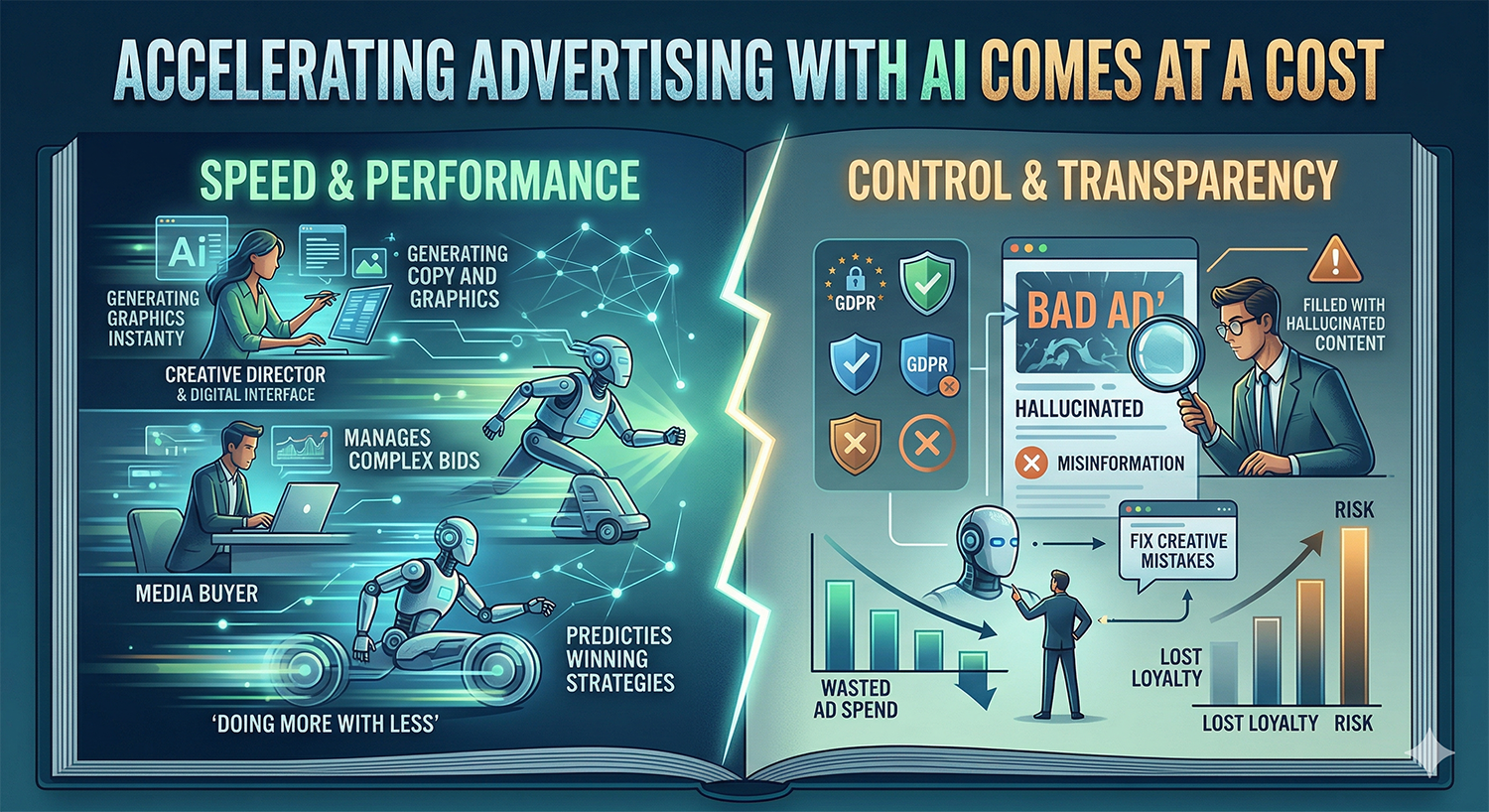
Take Alphabet, for example. They are leaning heavily into integrating Gemini models into Performance Max to speed up creative production and automate bidding. On paper, it’s a no-brainer: AI saves time, and better performance saves money. But as we sprint toward this automated future, we need to talk about the hidden tax: the loss of control and transparency.
Why the AI Obsession is (Mostly) Justified
It’s easy to see why everyone is hooked. When AI works, it feels like a superpower. Specifically, it’s changing the game in three major areas:
- Speed: AI is a massive accelerator for copywriting, image generation, and spotting data patterns. When 78% of CMOs are being told to “do more with less” this year, having a tool that identifies winning variables in seconds is a lifesaver.
- Insights: It takes the guesswork out of your ad spend. By predicting which audiences and creatives will actually perform, AI helps stop the “leaky bucket” of wasted budget.
- Creativity: We’re seeing brands use AI to break the fourth wall, creating viral, high-energy campaigns that actually resonate with people rather than just shouting at them.
The Dark Side of the “Auto-Pilot”
However, there’s a catch. When you implement AI as often as you talk about it, you start to distort your workflow. Creative directors and performance marketers are increasingly being asked to cede control to semiautonomous machines that can be, frankly, a bit capricious.
The risks aren’t just theoretical. Between hallucinations, regulatory hurdles, and “bad ads” that can tank brand loyalty in a heartbeat, the cost of an unmonitored AI can be a massive hit to your reputation.
Ready to dominate your local market? https://www.megavisionservices.com/managed-services/
How to Curate the Machine
AI isn’t new—it’s been part of media mix modeling since the 1950s. But today, it comes in three distinct flavors: Predictive, Generative, and Prescriptive. To actually win, you can’t just “set it and forget it.” Advertisers have to become curators, making active decisions on where the human stays in the loop and where the machine takes the lead.
The Agency Evolution (or Extinction)
This shift is creating a “sink or swim” moment for agencies. It’s estimated that by 2030, nearly one-third of agency jobs could be at risk of automation. Agencies that only offer “shallow” services—basic content generation or simple bid management—might find themselves replaced by a brand’s internal language model. The agencies that survive will be the ones that:
- Harness AI to supercharge intelligent creativity.
- Solve high-level C-suite problems like market share growth.
- Absorb the risk for the brand by providing the human oversight AI lacks.
AI is an incredible tool for acceleration, but it shouldn’t be the one driving the car without a licensed human in the passenger seat. If you want the rewards, you have to be willing to manage the risks.
How are you balancing automation with brand safety this year? I’d love to hear your thoughts.